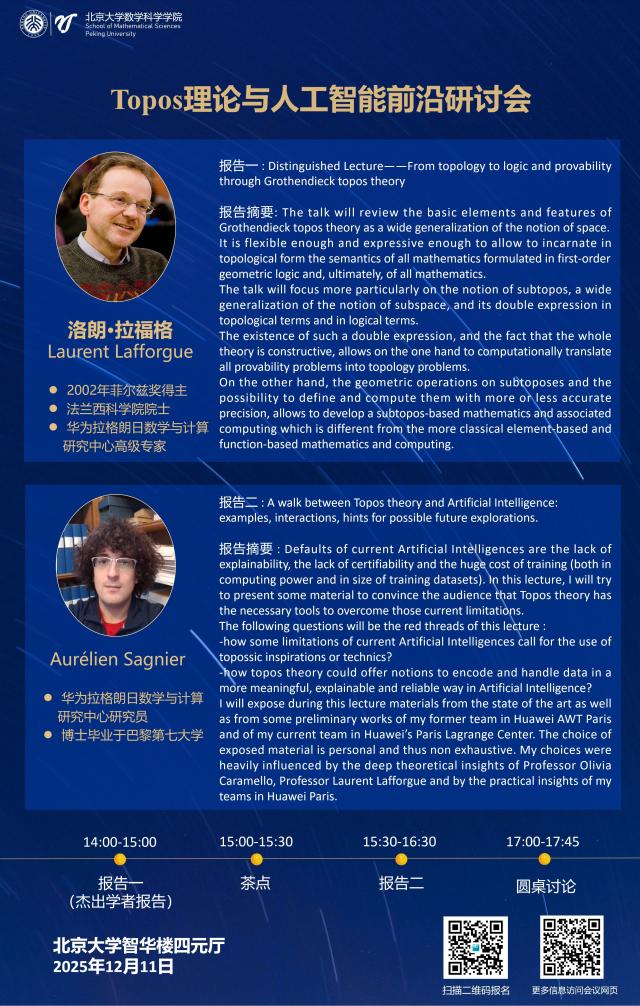
会议日期:2025年12月11日
会议地点:智华楼四元厅
会议流程:
14:00-15:00 报告一(杰出学者报告)
报告人:Laurent Lafforgue(2002年菲尔兹奖得主、法兰西科学院院士、华为拉格朗日数学与计算研究中心高级专家)
15:00-15:30 茶歇
15:30-16:30 报告二
报告人:Aurélien Sagnier(华为拉格朗日数学与计算研究中心研究员)
17:00-17:45 圆桌讨论
报名链接://f.wps.cn/g/rbqQlArc/
报告一 : Distinguished Lecture——From topology to logic and provability through Grothendieck topos theory
报告摘要: The talk will review the basic elements and features of Grothendieck topos theory as a wide generalization of the notion of space. It is flexible enough and expressive enough to allow to incarnate in topological form the semantics of all mathematics formulated in first-order geometric logic and, ultimately, of all mathematics.
The talk will focus more particularly on the notion of subtopos, a wide generalization of the notion of subspace, and its double expression in topological terms and in logical terms.
The existence of such a double expression, and the fact that the whole theory is constructive, allows on the one hand to computationally translate all provability problems into topology problems.
On the other hand, the geometric operations on subtoposes and the possibility to define and compute them with more or less accurate precision, allows to develop a subtopos-based mathematics and associated computing which is different from the more classical element-based and function-based mathematics and computing.
报告人介绍:Laurent Lafforgue is a mathematician. He worked mainly in algebraic geometry and harmonic analysis. He was awarded the Fields Medal in 2002 for his contribution to the “Langlands program”, which relates Galois Theory and Automorphic Representations Theory by applying Grothendieck’s general theories to the study of special moduli algebraic spaces discovered by Drinfeld. In the last decade, his main interest gradually shifted to Grothendieck Topos Theory. He moved to Huawei in 2021. At the Lagrange Center in Paris, which was created by Huawei but works as an academic institution, he collaborates with scientists from academia on the one hand and Huawei researchers on the other hand, especially Dr Aurélien Sagnier. He works on the development of Topos Theory, more particularly of Olivia Caramello’s Theory of “Toposes as Bridges”, and the elaboration of new forms of AI based on it.
报告二 : A walk between Topos theory and Artificial Intelligence: examples, interactions, hints for possible future explorations.
报告摘要 : Defaults of current Artificial Intelligences are the lack of explainability, the lack of certifiability and the huge cost of training (both in computing power and in size of training datasets). In this lecture, I will try to present some material to convince the audience that Topos theory has the necessary tools to overcome those current limitations.
The following questions will be the red threads of this lecture :
-how some limitations of current Artificial Intelligences call for the use of topossic inspirations or technics?
-how topos theory could offer notions to encode and handle data in a more meaningful, explainable and reliable way in Artificial Intelligence?
I will expose during this lecture materials from the state of the art as well as from some preliminary works of my former team in Huawei AWT Paris and of my current team in Huawei’s Paris Lagrange Center. The choice of exposed material is personal and thus non exhaustive. My choices were heavily influenced by the deep theoretical insights of Professor Olivia Caramello, Professor Laurent Lafforgue and by the practical insights of my teams in Huawei Paris.
报告人介绍:Aurélien Sagnier is a mathematician who obtained his PhD in 2017. His first field of study was topos theory and number theory (especially the program of Connes and Consani in number theory). He has joined Huawei in August 2022 as a research engineer. He is now in charge of an internal project whose aim to apply to AI the topossic insights of Professsor Olivia Caramello and of Professsor Laurent Lafforgue."